WORKTECH Singapore 2025 unfolded on 28 November at Standard Chartered’s headquarters in Marina Bay Financial Centre, bringing together a diverse community of HR leaders, workplace strategists, real estate consultants, designers, technologists, and organisational decision-makers.
Inavate was proud to support the conference as a media partner.
The programme opened with chairperson Neil Salton of ChangeWorq, who framed the current work landscape as one defined by recalibration.
Cost efficiency and workplace optimisation remain top of mind, but organisations are also reshaping the corporate real estate function into something more strategic and future-focused. Alongside this shift is a clear investment in AI upskilling and technologies that support more connected and intelligent workspaces.
Shelley Boland, global head of corporate real estate & services at Standard Chartered, emphasised that the office is far from disappearing, but there must be intentional efforts to make physical spaces inclusive and inviting. Even choices like art and sensory elements in an Standard Chartered’s offices are deliberate, illustrating how DEI considerations are now directly influencing spatial design.
The theme of purpose continued with Travis Foster from the Royal Automobile Club of Western Australia, who described purpose as the “invisible infrastructure” guiding the modern workplace. While data and technology dominate workplace conversations, he argued that purpose is what gives these tools meaning, allowing organisations to design ecosystems that genuinely connect people to place and work to value.
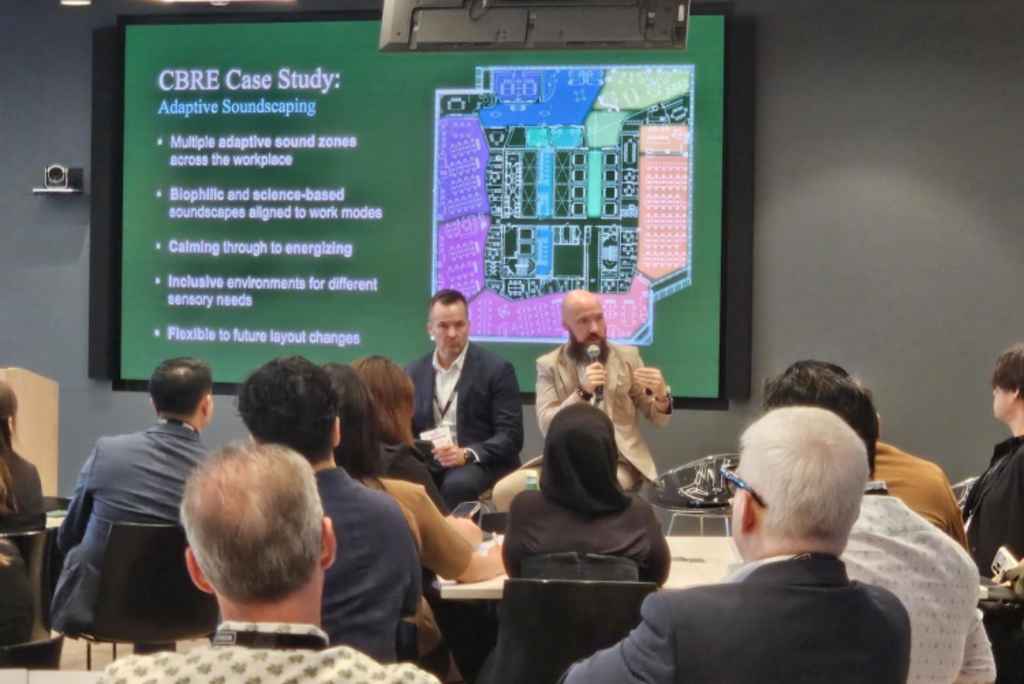
Technology’s role in shaping responsive, human-centred environments was explored further by Simon Long of CBRE and Marcus Rose of Valeo Technology. They described the workplace as a living system that senses, responds, and adapts to its stimuli, which in this case, is people. In practice, this means integrating technology rather than siloing it, and using metrics such as air quality and occupancy to inform decisions. Adaptive soundscapes, they noted, are one example of how design can evolve in real time.
Designers Primo Orpilla from Studio O+A and Yuki Kanamori from Kokuyo encouraged a rethink of workspace typologies. Orpilla compared the office entryway to a home’s porch, setting the first emotional impression of a workplace while Kokuyo emphasised the need for localisation in Asia, where cultural hierarchies, behaviours, and expectations differ significantly and should be reflected authentically in space planning.
Moving to real estate, Jasmine Lim of GuocoLand traced how real estate models have shifted from the early 2000s to today’s more utilisation-driven approaches. Lim shares the “office-as-a-service” model that Guoco Midtown has adopted, prioritising shared ecosystems of meeting rooms, lounges, and event spaces that tenants can access on demand. This reduces the need for large, seldom-used facilities within individual offices and aligns leasing models more closely with how people actually work.
Dr Jaclyn Lee of Certis then took over to discuss the link between culture, data, and workforce wellbeing. Data guides decision-making, she noted, but it is culture that builds trust, alignment, and a foundation for continuous learning.
As AI accelerates, Ar. Razvan Ghilic-Micu of Hassell urged the industry to remember what makes design human. While intelligent tools reshape output, creativity and authorship pushes designers to stretch beyond the reasonable. He advocates for more “narrative-based” workspaces, where storytelling lies at the heart of workplace environments.
A lively panel with Chloe Dervin from WebVine and Dinesh Malkani from Smarten Spaces explored personalisation, data overload, and the future of workplace AI. They predicted that personal agents will soon influence organisational culture, and that the next leap in spatial personalisation will move from apps to voice, and eventually, to completely frictionless interactions.
Rounding off the day, Jennifer Henderson of Standard Chartered and Kahn Yoon of M Moser Associates spoke about designing through a neurodivergent lens and the growing influence of hospitality spaces, like hotels, on workplace design.