Sixth Sense took over a repurposed heritage venue in India and transformed it into a multi-zone projection environment combining large-format mapping, dome visualisation and distributed spatial audio.
The project was delivered by Synergy Technologies, led by Chirag Patel, in collaboration with the Echoes of Earth team. The physical environment and overall property build were executed by Swordfish Events and Entertainment, creating the structural foundation on which the AV system was designed and deployed.
The experience was structured as a sequence of zones. Visitors moved through immersive projection rooms, a dedicated dome environment, and a monument-scale architectural mapping intervention, each requiring its own optical design, alignment strategy and content workflow.
As immersive formats become more prevalent across experiential, cultural and branded environments, projects such as Sixth Sense highlight the level of engineering discipline required behind the scenes. These themes will be explored further in Inavate India’s upcoming webinar on engineering immersive environments, where integrators and designers will examine optical planning, calibration workflows and content-to-surface alignment in multi-zone deployments.
Registration is open now
Blending, mapping and creating domes
The central immersive space is powered by 16 Christie DW 2400 series laser projectors, each delivering approximately 23,750 lumens at a native resolution of 1920 x 1200.
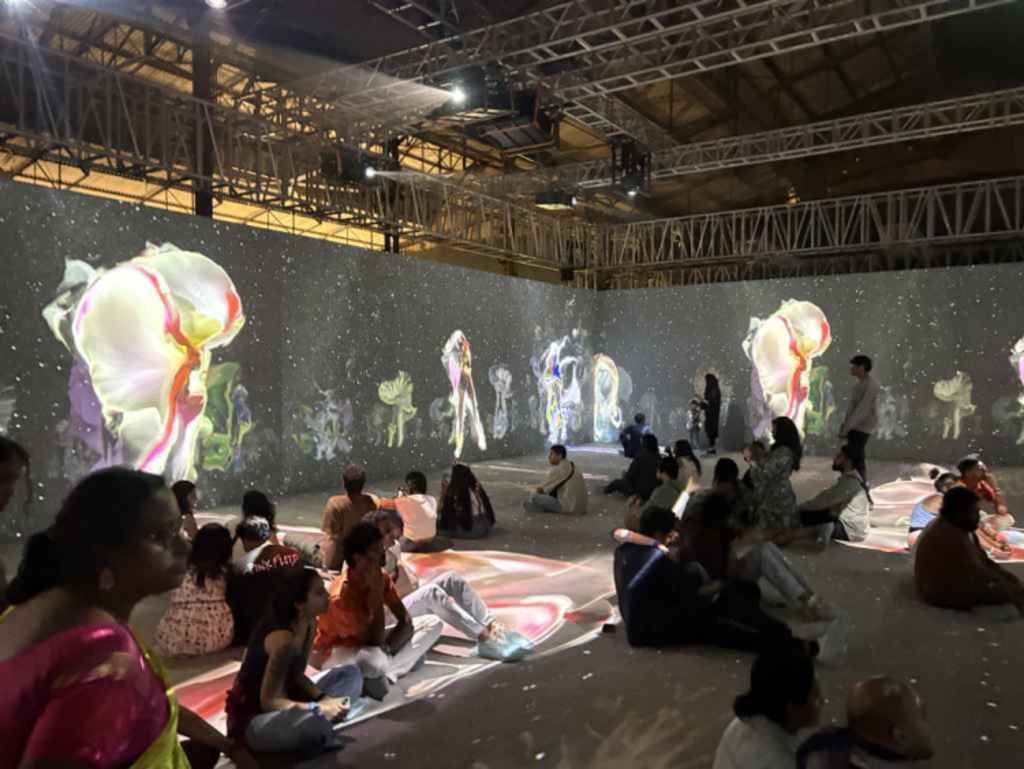
Signal transport runs over a fibre optic backbone using Lightware transmitter-receiver systems. Fibre distribution was selected to maintain signal integrity across the venue and minimise risk of degradation over distance. With no live camera relay in the system, overall latency is primarily dictated by media server GPU processing performance rather than transmission delay.
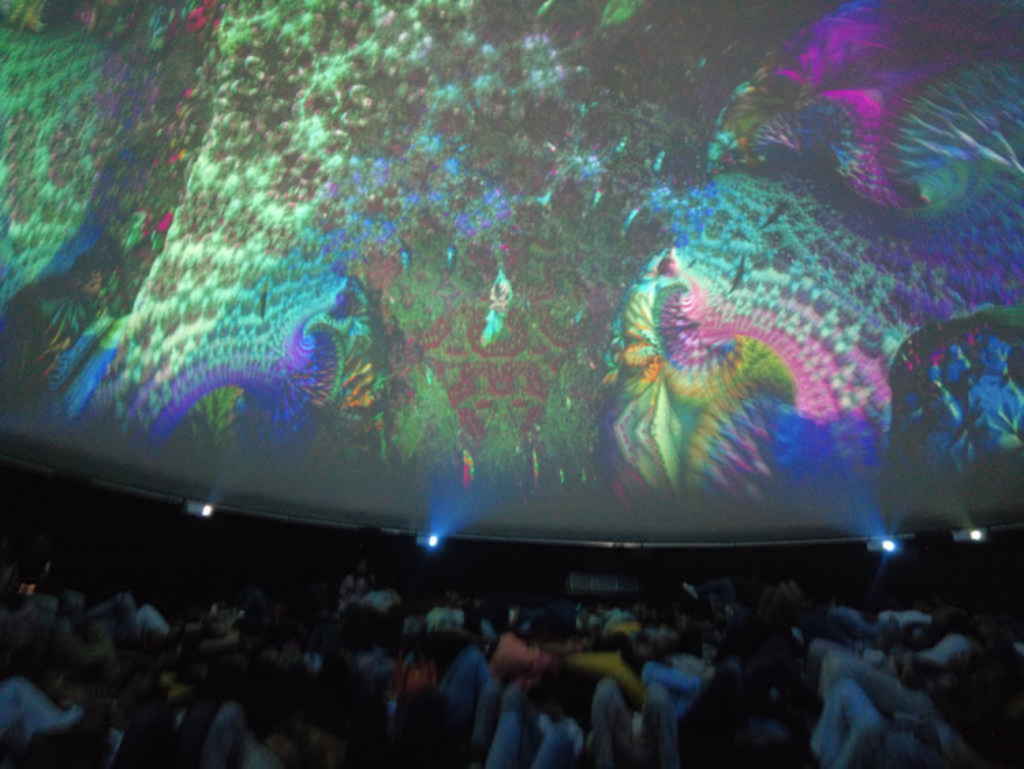
A dedicated dome environment within the venue is driven by eight laser projectors configured specifically for spherical geometry.
The final sequence in the visitor journey extended projection beyond interior immersion into architectural mapping. Designed and executed by Stefan Ihmig, the monument mapping installation used the venue’s facade as a mapped projection surface.
Running alongside the event was a TouchDesigner certification programme, giving participants direct access to live projection canvases inside the venue.
Audio integration
With multiple active spaces operating simultaneously, uncontrolled spill between zones would have quickly undermined the immersive intent. The audio system therefore had to be zoned, directional and tightly managed.
Distributed QSC systems were deployed across secondary zones, providing controlled coverage tailored to each spatial configuration. JBL reinforcement elements were integrated where additional impact and tonal shaping were required. In the primary performance area, an L-Acoustics centre-stage FOH configuration supported by V-DOSC arrays delivered the necessary scale and headroom for larger moments within the experience.
The design philosophy was not to compete with the projection canvas, but to support it. Loudspeaker positioning, coverage angles and system tuning were aligned with projection boundaries to maintain perceptual coherence.